
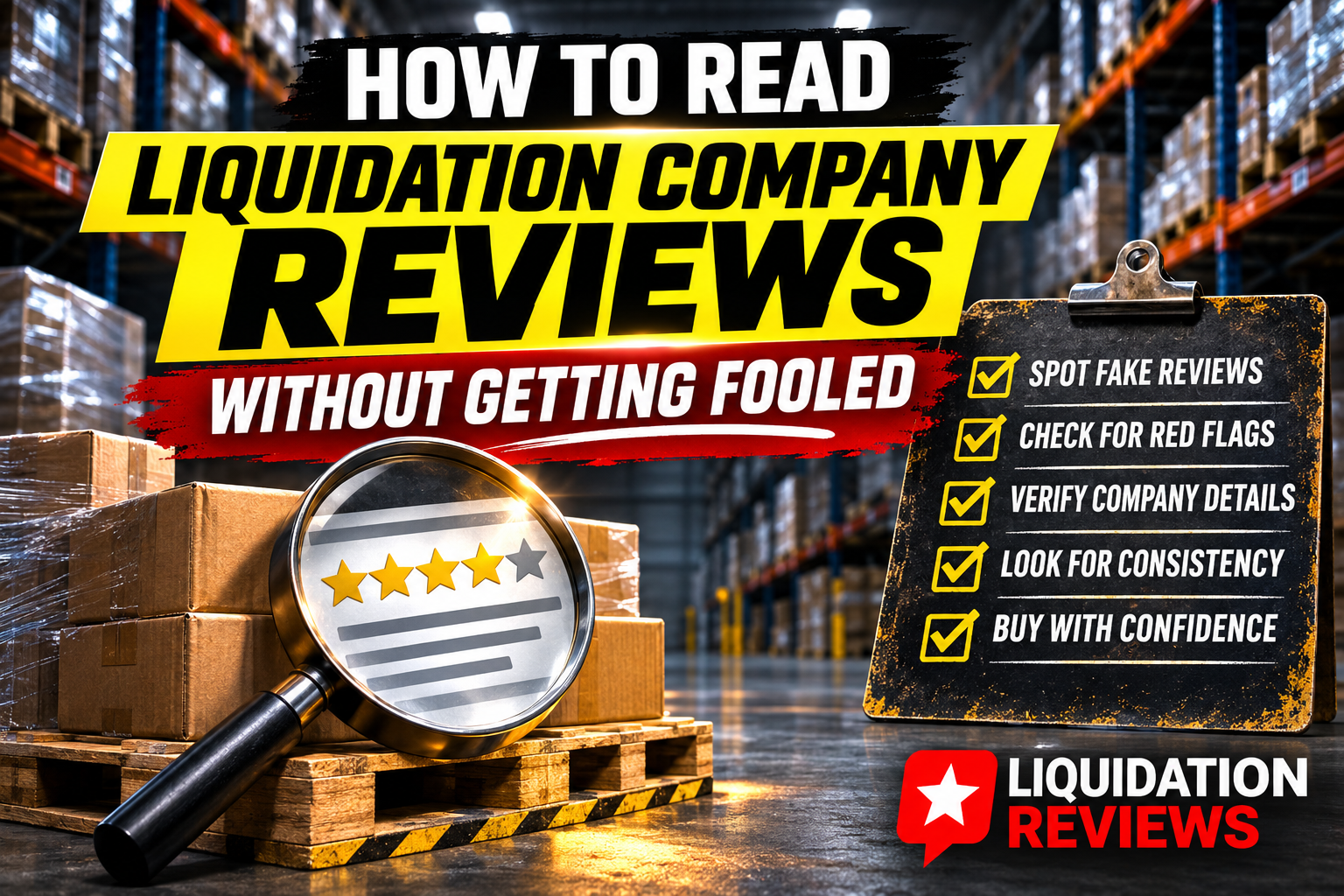
Liquidation is a risk-adjusted business. Customer returns, shelf pulls and overstock are sold at a steep discount because some of it will be damaged, missing parts or not what you hoped. A buyer who expected retail-grade goods and got a pallet with 15% unusable units will leave a harsh review, even if the manifest and listing terms said exactly that.
On the other side, happy buyers rarely write anything. They flip the goods, make their margin and move on. So the public record tilts toward the people who had a bad run or misread the terms. Keep that in mind before you treat a 3.2 average as a verdict.
If you'd rather start from a vetted list than sift through raw complaints, our Top Rated Liquidation Companies page ranks sources we've already checked for fees, manifest accuracy and how they handle disputes. Use it as the shortlist, then use the steps below to pressure-test any name on it, or any name that isn't.
Trustpilot is high volume and fast. It's good for spotting recent changes, like a company whose shipping times got worse this quarter. It's also the easiest platform to game, so read the middle of the rating range (two to four stars) first. Those reviews tend to be the most specific and the least emotional.
The BBB is slower but more formal. The useful part isn't the letter grade, which can be influenced by whether a business responds to complaints and pays for accreditation. The useful part is the complaint log: what category each one falls under, whether the company replied, and whether the issue was marked resolved. A company that answers every complaint with a real resolution is behaving very differently from one that ignores them.
Reddit is where you find the blunt, operational detail. Resellers talk about which pallets paid off, which categories are consistently overstated and how a company treated them after a problem. Reddit is anecdotal and sometimes biased by one loud thread, but you'll learn things there that never show up in a star rating. Search the company name plus words like "manifest," "freight" and "refund."
Fake reviews aren't always dramatic. More often they're a company nudging happy customers with a discount, or a burst of praise timed to bury a bad month. Look for these signals:
Clustered dates. Twenty glowing reviews in one week, then silence, is a flag. Real feedback arrives unevenly but steadily. Vague praise. "Great service, will buy again!" with no mention of what was bought, what arrived or how long it took tells you nothing. Genuine buyers usually mention a pallet type, a shipping quirk or a specific problem that got fixed. Reused phrasing. If several reviews share the same odd wording or structure, someone likely supplied a template.
Also check reviewer histories where the platform allows it. A profile with one review ever, posted for this company, carries far less weight than someone with a spread of reviews across different businesses. And be wary of any company that explicitly offers credit, free product or gift cards in exchange for a review. Incentivized reviews aren't automatically false, but they're not neutral either, so discount them.
This is the most important skill. One buyer got a pallet of cracked screens, and it's unfortunate. Fifteen buyers over three months describing the same manifest mismatch is a business practice.
I sort complaints into four buckets: product condition, manifest accuracy, fees and shipping, and customer service after a problem. Condition complaints are the most forgivable, since variance is part of the model. The other three are controllable by the company, so repeated complaints there matter much more.
Then I check three things. Is the same issue appearing across multiple platforms? Is it recent, or is it from a year ago under old management? And how did the company respond? A seller who replies with specifics and offers a fix is showing you how disputes will go. A canned reply or no reply is showing you the same thing.
Joel’s Rule: Joel's Rule: One complaint is a story, three similar complaints are a warning, and the same complaint across two platforms in the same quarter is a pattern. Treat it as one.
Not all negative reviews deserve equal weight. Rank them by how much they would cost you.
Refund and dispute failures sit at the top. If buyers say they were denied a remedy for a clearly mismatched manifest, or that the company went quiet after payment, walk away. Hidden fees come next: buyer's premiums, freight surcharges, lift-gate and residential delivery charges that appeared only at checkout. Manifest problems follow, such as listed items missing or substituted with cheaper ones. Condition grumbles, shipping delays within a reasonable window and "I didn't make money" complaints rank lowest, because they often reflect buyer inexperience or bad luck rather than company behavior.
Be careful with the last category. A review that says "total scam, lost money" and then describes buying unsorted returns at a thin margin isn't describing fraud. It's describing a risky category. Read for facts, not adjectives.
Here's the routine I'd run on any company before a first order. Spend about five minutes per platform.
Step 1: On Trustpilot, sort by newest and read the last 20 reviews, focusing on two- to four-star ones. Step 2: On the BBB, scan the complaint categories and note how many have company responses. Step 3: On Reddit, search the company name with "manifest," "freight" and "refund," and read the threads rather than the headlines. Step 4: Write down every repeated issue, then mark whether it's about condition, manifest, fees or service.
A quick example, using made-up numbers: say you read 20 recent reviews and 6 are negative. Five of those six mention condition on mixed returns, which the listing disclosed. One mentions a freight fee that wasn't shown upfront. That's a reasonable risk profile for the category. Now say 6 negative reviews all mention missing manifest items and slow refunds. Same count, much worse company.
Finally, read the seller's own terms. Reviews tell you what happened to others, but the return policy, fee schedule and manifest guarantees tell you what protection you actually have. Our liquidation buyers guide walks through what to look for in those terms before you commit to a first order.
No amount of research replaces a trial order. Once a company passes your review check, buy a small lot first. Compare the manifest to what arrives, note the total landed cost, and see how support responds if something is off.
That first order gives you a data point no stranger's review can. Good liquidation company reviews narrow your options and flag the risks. Your own test order confirms whether a source deserves more of your budget.
Want a shortlist that's already been vetted?